Play Jackpot Bells Now!
Home → Bonus Features
Jackpot Bells Bonus Features
Bonus features of Jackpot Bells
The developer Playtech constructs this 5x3 reel layout with a theoretical return to player rate of 96.03% over extended sessions, establishing a house edge of 3.97% for the operator. This percentage represents the long-term average payout expectation across hundreds of thousands of spins rather than a guarantee for individual gaming sessions or short-term play cycles. Players engaging with the medium volatility profile can expect balanced win frequency, though the maximum potential payout is capped at 37,500x the total wagered amount during standard gameplay rounds.
This slot title utilizes five fixed paylines where classic fruit-machine symbols align to generate wins, contrasting sharply with Alles Spitze which offers high volatility and a lower 90.85% RTP alongside a modest 500x max win cap. The progressive jackpot feature allows players to accumulate substantial prizes without needing special bonus triggers, relying instead on random number generator outcomes within the base game matrix. Consequently, the bet range between 2.00 and 25.00 determines the stake level for each spin, directly influencing the potential monetary value of any winning combination achieved on the active lines.
Free spins round
The Triple Money Jackpot Bells variant introduces a wheel-triggered jackpot mechanism that operates independently from standard free spins activations, focusing instead on direct prize multipliers via the spinning wheel interface. Unlike traditional scatter-based free spin rounds, this specific feature requires landing specific symbols to activate the wheel, offering a distinct mechanical difference from other Playtech titles in the market. The maximum win potential remains consistent at 37,500x, ensuring that even without free spins, the game retains its high-value payout structure for players seeking large jackpots.
Trigger conditions
Specific symbol combinations on the five-reel grid must appear simultaneously to activate the progressive jackpot component, requiring precise alignment across the defined paylines to qualify for the top-tier prize pool accumulation. This mechanic differs significantly from Alles Spitze, where the Merkur brand relies on different trigger logic and maintains a much lower 90.85% RTP compared to the 96.03% offered here. Players betting within the 2.00 to 25.00 range contribute to the progressive pool, with higher stakes potentially increasing the overall prize visibility but not altering the fundamental triggering probability per spin.
Retriggers and extensions
Standard free spins cannot be retriggered in this specific version as the core loop focuses on the progressive jackpot accumulation rather than repeated bonus round activations, limiting extension possibilities for players. The absence of retrigger mechanics means the session length depends entirely on the base game volatility, which remains medium, providing a steady stream of small to medium wins between jackpot attempts. This design choice contrasts with games offering unlimited retrigger potential, instead capping the bonus duration while maintaining the 96.03% RTP expectation over the long term for all participants.
Multiplier mechanics
The wheel-triggered jackpot in the Triple Money variant applies direct multipliers to the current balance upon activation, bypassing traditional multiplier mechanics found in standard free spins rounds of other slots. This approach ensures that the 37,500x max win cap is reachable through single events rather than accumulated multipliers, offering a clearer path to large payouts for users betting up to 25.00 per spin. Such a system provides transparency regarding potential returns, differing from complex multiplier chains that often obscure the actual mathematical advantage held by the house within the 3.97% edge.
Jackpot Bells: key facts
| Parameter | Value |
|---|---|
| Game | Jackpot Bells |
| Studio | Playtech |
| RTP | 96.03% |
| House edge | 3.97% |
| Volatility | medium |
| Max win | 37,500x |
| Reels | 5x3 |
| Paylines / ways | 5 |
| Bet range | 2.00 – 25.00 |
Bonus buy option
The Jackpot Bells online slot developed by Playtech does not include a bonus buy feature in its standard configuration, meaning players cannot pay an immediate fee to trigger the progressive jackpot or the wheel-triggered variant found in Triple Money Jackpot Bells. This absence forces users to rely on base game spins to land the necessary scatter symbols for feature activation, which alters the pacing of mobile play sessions significantly. The lack of a direct purchase path ensures that the medium volatility remains consistent across all spins rather than being skewed by instant access costs.
Mobile players seeking instant gratification might compare this limitation to Book of Dead by Play'n GO, which also lacks a bonus buy but offers high volatility and a max win of 5000x for those willing to endure longer dry spells without purchasing features. While Book of Dead provides a different risk profile with its 96.21% RTP, Jackpot Bells maintains a theoretical return of 96.03%, offering a slightly lower house edge of 3.97% over the long run for patient spinners. This distinction matters for bankroll management, as the fixed bet range from 2.00 to 25.00 applies uniformly regardless of any potential feature triggers.
The restriction against buying bonuses aligns with the classic fruit-machine symbols used in Jackpot Bells, preserving the traditional arcade feel where rewards are earned through persistence rather than upfront payment. Players must accept that the maximum win of 37,500x is only reachable through natural gameplay progression, requiring discipline to stay within the defined bet limits during extended losing streaks. This design choice protects casual mobile gamers from impulsive spending while still allowing dedicated users to chase the substantial progressive jackpot potential inherent in the Playtech title.
Cost of buying the feature
Since the Playtech slot Jackpot Bells omits a bonus buy mechanic entirely, there is no specific cost associated with purchasing features, contrasting sharply with modern slots that charge premiums for instant access to free spins or multipliers. The absence of such a fee means the minimum stake of 2.00 € represents the sole financial entry point for every spin, keeping costs predictable for mobile users managing tight budgets. This structure eliminates the risk of overspending on feature triggers, ensuring that the medium volatility plays out according to the stated 96.03% RTP without additional markup charges.
Comparing this zero-cost model to Book of Dead by Play'n GO highlights a fundamental difference in game design philosophy, where the latter focuses on high volatility outcomes with a 5000x max win cap rather than optional feature purchases. Although Book of Dead operates at a 96.21% RTP, neither title allows players to bypass the random number generator through paid shortcuts, maintaining fair play standards for both platforms. Consequently, the budget allocation for Jackpot Bells remains strictly tied to the per-spin cost, with no hidden fees or optional add-ons disrupting the mathematical expectation of the game.
The economic implication for mobile players is that their entire bankroll is dedicated to base game spins, maximizing the number of attempts to hit the progressive jackpot or the Triple Money variant wheel. With a house edge of 3.97%, every euro wagered contributes directly to the theoretical return over hundreds of thousands of spins, without any portion being diverted to feature acquisition fees. This transparency allows users to calculate their expected loss rate accurately based on the bet range of 2.00 to 25.00, fostering a more sustainable gaming session on handheld devices.
Is the feature buy worth it
The question of whether a feature buy is worth it becomes moot for Jackpot Bells because the Playtech developer has excluded this option, forcing reliance on the standard 5-reel, 3-row layout to trigger events naturally. This design prevents players from paying a premium that could skew the medium volatility, ensuring that the 96.03% RTP remains the primary metric for evaluating long-term performance rather than short-term feature access. Mobile users benefit from this simplicity, as they do not need to weigh complex cost-benefit analyses before each spin, reducing decision fatigue during extended play sessions.
In contrast, titles like Book of Dead by Play'n GO offer a different experience with high volatility and a 96.21% RTP, appealing to players who prefer higher risk and larger potential payouts up to 5000x without needing to purchase features. While Jackpot Bells caps its max win at 37,500x through its progressive jackpot, the absence of a buy option means players cannot accelerate their path to this reward, maintaining a steady engagement pace. This distinction suits users who prioritize consistent entertainment value over the thrill of rapid feature activation, aligning with the classic fruit-machine aesthetic.
The strategic advantage of excluding a feature buy lies in preserving the integrity of the betting system, where stakes between 2.00 and 25.00 determine the exposure to the house edge of 3.97%. Players cannot inflate their risk profile artificially by purchasing bonuses, which encourages disciplined bankroll management and longer playing times on mobile devices. This approach ensures that the medium volatility delivers balanced wins and losses, providing a stable gaming environment that avoids the extreme swings associated with high-volatility alternatives or purchased features.
Base game versus bonus returns
The base game of Jackpot Bells utilizes classic fruit-machine symbols on a 5x3 reel grid, generating returns that contribute to the overall theoretical RTP of 96.03% set by Playtech. Without a bonus buy mechanism, the frequency of winning combinations depends entirely on the medium volatility settings, which balance smaller regular payouts against the potential for hitting the progressive jackpot. Mobile players observe that the base game forms the backbone of earnings, with the 5 paylines offering frequent small wins that sustain the bankroll until major features trigger naturally.
Bonus returns in Jackpot Bells are primarily linked to the progressive jackpot and the wheel-triggered version in Triple Money, which can yield the maximum win of 37,500x but require specific scatter alignments to activate. Unlike Book of Dead by Play'n GO, where bonus rounds often provide multipliers and expanding wilds for a 5000x cap, Jackpot Bells focuses on jackpot accumulation, making the base game crucial for funding the spins needed to reach these high-tier rewards. The 96.03% RTP encompasses both base and bonus phases, ensuring that the total return remains consistent regardless of how often features trigger.
The comparison with Book of Dead reveals that while Play'n GO's title offers high volatility with a 96.21% RTP and a 5000x max win, Jackpot Bells provides a more gradual progression toward its 37,500x potential through medium volatility. This difference means that base game returns in Jackpot Bells are generally more stable, with fewer extreme drops in balance compared to high-variance slots. Players relying on the 2.00 to 25.00 bet range can expect a smoother experience, as the medium volatility mitigates the risk of rapid depletion while still allowing access to significant jackpot prizes over time.
Feature frequency in practice
Feature frequency in Jackpot Bells is governed by the medium volatility setting, which dictates how often the progressive jackpot or wheel-triggered bonus appears during standard play sessions on mobile devices. Since the Playtech slot lacks a bonus buy option, players must endure the natural randomness of the 5 paylines, with the theoretical RTP of 96.03% indicating that returns are distributed over a very long run. This medium variance ensures that features do not appear too frequently to deplete balances quickly, nor too rarely to cause frustration, striking a balance suitable for sustained engagement.
When comparing feature frequency to Book of Dead by Play'n GO, the latter's high volatility results in less frequent but potentially larger bonus triggers, capped at a 5000x max win with a 96.21% RTP. Jackpot Bells, with its 37,500x max win and 96.03% RTP, offers a different rhythm where features may occur less spectacularly but with greater consistency due to the medium volatility classification. Mobile users should anticipate that the base game will dominate their session, with bonus rounds serving as periodic enhancements rather than the primary source of income, especially given the bet range of 2.00 to 25.00.
The practical implication for players is that the medium volatility requires patience, as the house edge of 3.97% applies continuously to every spin within the defined bet limits. Unlike high-volatility games that promise infrequent big hits, Jackpot Bells provides a steadier stream of wins that help maintain the bankroll while chasing the progressive jackpot. This frequency pattern supports responsible gaming habits, as players can monitor their progress against the 96.03% RTP without experiencing the severe swings associated with rare feature activations in other titles.
Special mechanics of this title
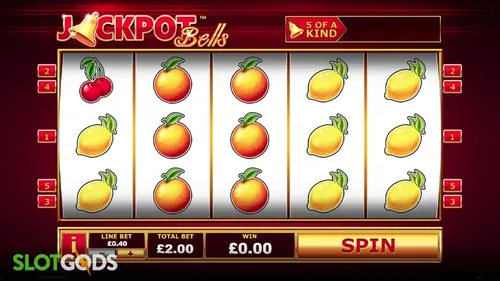
The Jackpot Bells slot utilizes a 5x3 reel layout with exactly five paylines, creating a straightforward grid structure for symbol matching that differs significantly from the complex cluster-pay mechanics found in modern video slots. This specific configuration limits the potential for intricate bonus triggers compared to games like Big Bass Splash which employs a 5x3 setup but relies on high volatility for its scatter-based free spin rounds rather than fixed line wins. Players must align symbols across these five distinct paths to secure payouts, meaning the hit frequency is dictated by the medium volatility setting rather than random feature activation. Consequently, the gameplay remains predictable and focused on traditional fruit-machine aesthetics without the distraction of advanced mathematical models or expanding wilds.
Playtech designed this game to deliver a maximum win cap of 37,500x the total bet, establishing a clear upper limit for player returns that contrasts sharply with the 5,000x ceiling seen in other popular titles such as Big Bass Splash. The theoretical return to player stands at 96.03%, ensuring a house edge of 3.97% over an extended period, which provides a standard baseline for long-term bankroll management strategies. This percentage is not guaranteed for short sessions but represents the statistical average across hundreds of thousands of spins, defining the expected value for every euro wagered on the reels. Therefore, players should anticipate variance around this mean, understanding that individual results will fluctuate widely above and below the stated return rate during typical play sessions.
How the studio built the maths
The developer Playtech implemented a medium volatility profile for Jackpot Bells, balancing the frequency of small wins against the rarity of larger payouts to maintain engagement without excessive bankroll depletion. This mathematical model ensures that while big hits are less common than in low-variance games, they occur often enough to keep the player interested, unlike the high volatility structure of Big Bass Splash which can endure long dry spells between significant rewards. The RTP of 96.03% serves as the foundational parameter for this balance, calculated over millions of simulated spins to guarantee the advertised return percentage holds true statistically. As a result, the game offers a steady stream of activity that suits players seeking consistent entertainment rather than chasing rare, high-risk jackpots typical of extreme volatility titles.
Feature variants and levels
The primary version of Jackpot Bells features a progressive jackpot system triggered by landing specific bell symbols, whereas the Triple Money Jackpot Bells variant introduces a wheel-triggered jackpot mechanic that adds a layer of interactive chance to the base game. These two configurations represent distinct mathematical approaches to reward distribution, with the latter offering a different risk-reward profile due to the randomized nature of the wheel outcome compared to the fixed probability of the main game's progressive trigger. Understanding this distinction is crucial for players who may encounter either version, as the payout structures and triggering conditions differ significantly between the classic fruit-machine style and the bonus-wheel variant. Players should verify which version they are playing to accurately assess their chances of hitting the top prize and manage their expectations accordingly based on the specific rules in effect.
What the bonus can pay
The maximum win potential for Jackpot Bells reaches 37,500x the stake, allowing a single spin to generate substantial returns when the highest paying symbols align perfectly on one of the five active paylines. This ceiling is considerably higher than the 5,000x max win offered by Big Bass Splash, indicating that Playtech has engineered the math model to support larger payouts despite the lower volatility setting. For a player betting the maximum amount of 25.00 per spin, a full win would equate to 937,500 units of currency, demonstrating the significant upside available within the game's parameters. Such a payout event is rare due to the medium volatility, but it provides a compelling target for players willing to endure the inherent variance associated with progressive jackpot mechanics.
What the feature costs in practice
Each spin on Jackpot Bells costs between 2.00 and 25.00, defining the minimum and maximum financial commitment required to participate in the game's core mechanics and progressive jackpot opportunities. This bet range allows for flexible bankroll management, enabling players to adjust their stakes according to their budget while still accessing the full feature set including the three jackpot tiers. At the maximum bet of 25.00, the cost per hour can accumulate rapidly depending on spin speed, highlighting the importance of setting strict loss limits before beginning a session. Players must account for this variable expense when calculating their total turnover requirements, as higher bets increase both the potential reward and the rate of bankroll erosion during losing streaks.
DemoRTP & VolatilitySymbols & PayoutsBonus FeaturesStrategyBonusesMobileDownload & AppMax WinSimilar GamesReviewFAQSitemap
Jackpot Bells 2026